
Most people who receive a sleep apnea diagnosis are surprised. They assumed it was a weight issue, an aging issue, or something that only happened to people who were severely out of shape. What they did not expect was their doctor asking, does anyone in your family have this?
That question is not routine small talk. Family history is one of the strongest clinical signals a physician uses when evaluating sleep apnea risk. Understanding what you actually inherit, and what that means for your health, gives you something most people never act on until symptoms become impossible to ignore.
Does Sleep Apnea Run in Families?
The risk of developing obstructive sleep apnea is approximately 50% greater for first-degree relatives of people with the condition compared to the general population, according to the U.S. National Library of Medicine. First-degree relatives include parents, siblings, and children.
Inherited factors may account for as much as 30% to 70% of overall obstructive sleep apnea risk, with research consistently showing that nearly 40% of the variance in a person’s Apnea-Hypopnea Index score, the clinical measure used to grade apnea severity, can be explained by familial factors alone.
Sleep apnea is not passed down the way a single-gene condition is. You do not inherit the disorder directly. What you inherit are the physical and physiological traits that make airway collapse during sleep more likely. That distinction matters because it changes how you think about your own risk.
What You Actually Inherit
Jaw and Facial Bone Structure
Craniofacial anatomy is one of the strongest hereditary markers for obstructive sleep apnea. The jaw characteristics most associated with elevated risk include a recessed lower jaw, known clinically as retrognathia, a small upper jaw, a high-arched palate, and a narrowed pharyngeal space.
When the lower jaw sits further back than normal, the tongue and soft tissues lose forward support during sleep. As muscle tone naturally drops, those tissues fall back toward the airway and obstruct breathing. A shorter neck, a narrower throat, and a longer soft palate are also features that can be inherited and that increase the likelihood of nighttime airway collapse.
These craniofacial traits are not visible from the outside. Two people can appear similar in build and body weight, yet one can have inherited an airway geometry that puts them at significantly higher risk than the other.
Upper Airway Size and Shape
Some people are born with a pharynx that has less room for soft tissue movement before obstruction occurs. The shape and caliber of the upper airway are primarily determined by genetics, though developmental factors can also influence it over time.
A large tongue relative to the size of the mouth, enlarged tonsils relative to the airway, and a naturally narrow pharynx are all traits with hereditary components. None of these are visible on the outside, but all of them directly affect what happens the moment muscle tone drops during sleep.
Body Fat Distribution
Genetics influences not just whether someone carries excess weight, but where the body stores it. Fat deposits in the neck and upper torso are particularly relevant to sleep apnea because fatty tissue around the throat reduces the space available for airflow and places direct pressure on the upper airway.
Clinical evaluation guidelines from the American Academy of Sleep Medicine identify a neck circumference greater than 17 inches in men or 16 inches in women as a recognized risk indicator for obstructive sleep apnea. The tendency to accumulate weight in that region, rather than elsewhere in the body, has a genetic basis that is independent of overall body weight. Two people with similar total body weight can carry very different levels of sleep apnea risk based on where that weight is distributed.
How the Brain Controls Breathing
The brain’s response to dropping oxygen and rising carbon dioxide levels during sleep also varies by genetics. The ventilatory control system, meaning how quickly and accurately the brain detects and responds to airway obstruction, differs between individuals. People whose neurological response is less sensitive are more likely to experience prolonged apnea events before the airway reopens.
No single gene causes obstructive sleep apnea. The condition develops through a combination of inherited traits that cluster in families, spanning craniofacial structure, airway anatomy, fat distribution patterns, and ventilatory control. Each trait on its own may be minor. Together, they can cross the threshold into a diagnosable and clinically significant condition.
Can You Have Sleep Apnea If You Are Not Overweight?
A person can be lean, physically fit, and at a healthy body weight and still have moderate to severe obstructive sleep apnea. The reason is anatomy. If you have inherited a recessed jaw, a narrow pharynx, or a large tongue relative to your airway, the structural obstruction exists regardless of how much you weigh.
Weight is a risk amplifier. Anatomy is the foundation. The two are independent of each other. Many patients with entirely normal body weight and no other obvious risk factors carry significant sleep apnea that goes undiagnosed for years precisely because they do not fit the assumed profile.
This is directly relevant to anyone with a family history. You do not need to gain weight for inherited anatomy to become a clinical problem. Age-related changes in muscle tone alone can be enough to tip an already narrow airway into obstruction.
If a Parent Has Sleep Apnea, Will You Get It?
Having the genetic predisposition means the threshold for developing sleep apnea is lower for you than for someone without that family history. Other factors, such as weight gain, aging, menopause, alcohol use, or sedative medications, can push you past that threshold faster than they would for someone without the hereditary component.
The practical implication is that family history is a reason to pay attention to symptoms earlier, not a reason to assume a diagnosis is inevitable. Fatigue that does not resolve with adequate sleep, waking with morning headaches, snoring a partner notices, difficulty concentrating during the day, waking at night with a dry mouth or a sense of gasping, all of these are worth discussing with a physician when sleep apnea runs in your family.
What Is the Most Common Cause of Obstructive Sleep Apnea?
The most common cause of obstructive sleep apnea is the combination of upper airway anatomy and the natural relaxation of throat muscles that occurs during sleep. When muscle tone drops, the structural characteristics of the airway determine what happens next. A wider airway with a well-positioned jaw tolerates that relaxation without obstruction. A narrower airway with a recessed jaw often cannot.
Obesity is the most frequently cited modifiable risk factor, and its contribution is real. Excess fatty tissue in the neck and head region constricts the airway, while abdominal fat reduces lung expansion capacity. In people with normal body weight, inherited anatomy is typically the primary driver.
Both pathways lead to the same clinical outcome: repeated airway collapse during sleep, dropping oxygen levels, and a body under chronic physiological stress throughout the night, even when the person has no awareness of it.
Why Family History Changes the Clinical Conversation
When a physician evaluates a patient for sleep apnea in a practice like ours in Brunswick, Georgia, family history shapes the clinical picture from the first appointment. It raises the level of suspicion even when other visible risk factors appear absent, and it informs how thoroughly the evaluation needs to proceed.
The anatomical dimension of sleep apnea risk is where the expertise of an oral and maxillofacial surgeon becomes directly relevant. Jaw position, palate shape, airway geometry, and tongue volume relative to the oral cavity are structural features that a surgeon trained in the head and neck region evaluates with a level of precision that a general clinical assessment cannot replicate.
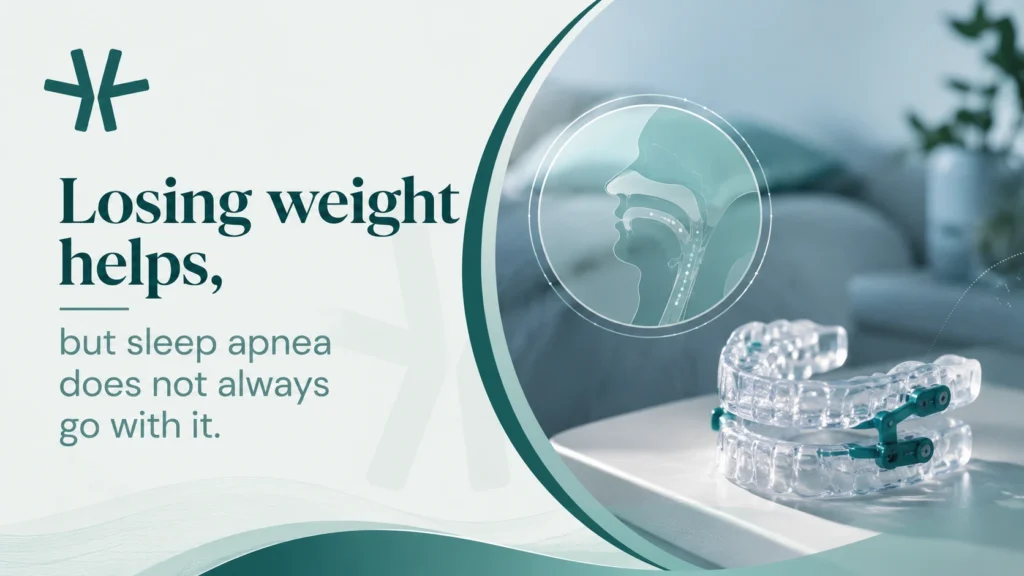
A custom oral appliance works because it repositions the jaw during sleep, maintaining the airway that anatomy would otherwise allow to collapse. That repositioning needs to be calibrated to the specific anatomy of each patient, titrated to their specific apnea severity, and monitored over time by someone with the clinical background to understand what the device is doing structurally.
That level of anatomical understanding is what separates a medically guided oral appliance from anything available over the counter.
Genetics Raises Your Risk. Your Outcome Is Still in Your Hands.
Family history is useful, actionable information that can lead to earlier evaluation, earlier diagnosis, and more effective treatment. It is not a certainty, and it is not a sentence.
Sleep apnea is one of the most treatable conditions in medicine. For patients who cannot tolerate CPAP or who prefer a less invasive long-term option, custom oral appliance therapy is effective, well-tolerated, and covered by most major medical insurance plans. The device is small, quiet, and calibrated to the patient’s specific anatomy and severity.
People who complete treatment consistently report better sleep, more energy during the day, clearer thinking, and improved mood. Their partners notice the difference too.
Find Out Where You Stand
Family history is not a diagnosis. But it is a reason to stop guessing and start getting real answers.
If you have been tired longer than you can explain, waking up without feeling rested, or someone close to you has mentioned your breathing at night, those are not things to keep brushing off. They are signals worth paying attention to, especially when sleep apnea runs in your family.
Innova Sleep Institute in Brunswick, Georgia, works with patients who are exactly where you are right now, aware that something may be wrong but not yet sure what to do about it. A proper evaluation gives you a clear picture of how your airway functions while you sleep and a path forward tailored to your specific situation.
The earlier you know, the more you can do about it. Call (912) 400-6914 to schedule your consultation.