Zepbound can reduce the frequency of airway collapse during sleep. For some patients, it reduces sleep apnea events significantly. For others, the airway still obstructs after weight loss because the problem was never only about weight. Whether you still need an oral appliance depends on your airway anatomy, your AHI after treatment, and whether the weight stays off long-term.
Why Patients Are Asking This Question Right Now
In December 2024, the FDA approved tirzepatide, sold as Zepbound, as the first-ever prescription medication specifically for obstructive sleep apnea. Before that approval, every treatment for OSA was mechanical: CPAP, an oral appliance, or surgery. The idea of a weekly injection that could reduce sleep apnea events was genuinely new, and patients started asking reasonable questions.
If the drug reduces my AHI, do I still need a device?
It is a fair question. The answer depends on why your airway is obstructing in the first place.
What the SURMOUNT-OSA Trials Actually Showed
The FDA approval was based on two phase 3 clinical trials called SURMOUNT-OSA. Participants were adults with moderate-to-severe OSA and obesity, with a baseline AHI of roughly 50 events per hour. After 52 weeks on tirzepatide at 10 to 15 mg:
- Average AHI dropped by approximately 27 to 30 events per hour
- Average body weight fell by 18 to 20 percent
- Up to 51.5 percent of participants reached a point where OSA was classified as resolved on objective testing
Those numbers are real and clinically meaningful.
What often gets left out: roughly half of participants still had measurable residual sleep apnea at the end of the trial, even after losing close to 50 pounds. The drug reduced severity. It did not eliminate the structural problem for everyone.
Why Weight Loss Alone Does Not Always Resolve Sleep Apnea
Here is the piece that requires actual airway expertise to explain clearly.
Obstructive sleep apnea is not only a weight problem. It is a geometry problem.
When you sleep, the muscles that hold your upper airway open relax. In patients with OSA, the airway narrows or collapses completely during that muscle relaxation. Weight contributes to that collapse because fat tissue in the tongue, soft palate, and neck walls crowds the airway. Losing that tissue reduces the crowding.
But the shape of your airway, the position of your jaw, the length of your soft palate, the size of your tongue base, the anatomy of your oropharynx, none of that changes with medication. Patients whose OSA is primarily driven by craniofacial structure and jaw position can lose substantial weight and still wake up dozens of times a night because the airway is closing for reasons that have nothing to do with fat tissue.
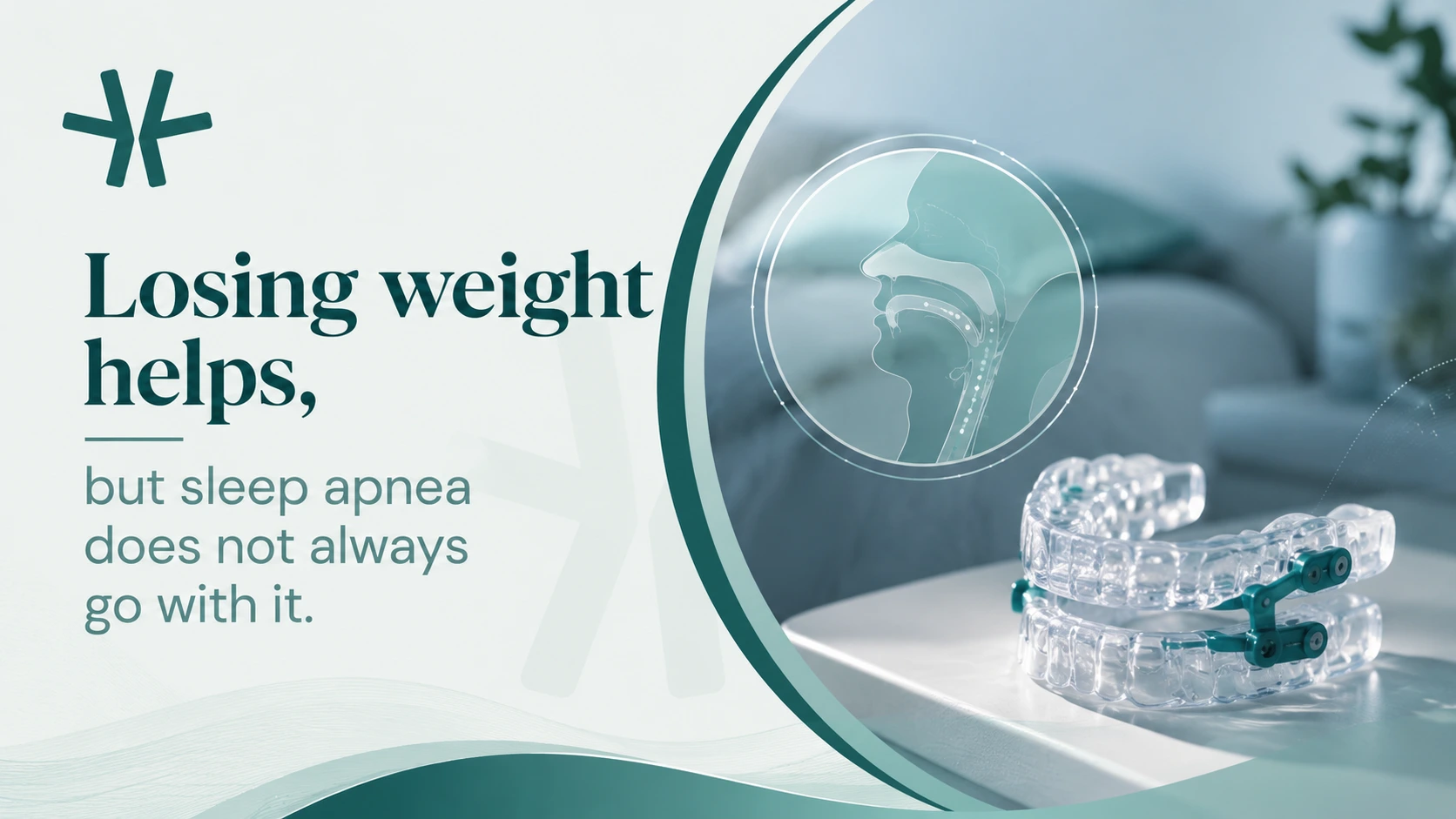
A custom titratable oral appliance works by repositioning the mandible forward during sleep. That mechanical repositioning holds the airway open in a way that weight loss alone cannot replicate. These are two different mechanisms addressing two different contributors to the same condition.
This is also why a follow-up sleep study after significant weight loss on Zepbound is not optional. It is the only way to know whether your AHI has reached a clinically safe level, and it is the only way to decide whether device therapy can be reduced, modified, or continued as-is.
The Discontinuation Problem Nobody Talks About
Sixty-six percent of patients who stop tirzepatide regain the weight. That figure comes from clinical trial data. It is not a criticism of the medication; it reflects the biology of obesity and the way GLP-1 drugs work. When you stop the drug, hunger signals return and body weight trends back toward baseline.
What that means for sleep apnea: the airway exposure returns with the weight.
A patient who stops Zepbound without a confirmed structural treatment plan is in a gap period. Their OSA severity has likely returned to something close to baseline, but they may not have symptoms obvious enough to prompt a new sleep study right away. That gap, weeks to months of untreated or undertreated OSA, carries the same cardiovascular and metabolic risks as undiagnosed OSA: elevated blood pressure, cardiac arrhythmia risk, impaired glucose regulation, and accelerated cognitive effects.
An oral appliance does not depend on consistent injections, weight maintenance, or insurance coverage continuing. It works every night regardless of what happens metabolically. For patients using both, the appliance provides a reliable structural floor while the medication addresses the metabolic load.
Who Still Needs an Oral Appliance While on GLP-1 Therapy
Not every OSA patient on Zepbound needs combination therapy. The clinical picture varies. Patients more likely to still need an oral appliance include:
Those with a non-obese body type and OSA — If your OSA was not primarily driven by obesity, Zepbound is not approved for your indication, and weight loss will not meaningfully change your AHI.
Those with residual AHI above 15 after weight loss — An AHI above 15 events per hour still meets the threshold for moderate sleep apnea. That level of airway obstruction carries real health risk and should not be left unaddressed.
Those with craniofacial or jaw anatomy contributing to obstruction — Retrognathia, a small lower jaw, a large tongue base, or a narrow palatal arch contribute to OSA in ways that no weight loss drug corrects.
Those tapering off or discontinuing Zepbound — This is arguably the highest-risk window. Structural treatment should be in place before any tapering happens.
Those on Zepbound who were already CPAP-intolerant — If you could not tolerate CPAP, that does not change because you started a GLP-1. An oral appliance remains the most practical structural option for this group.
How a Medical Evaluation Changes the Conversation
The question of whether you need an oral appliance, GLP-1 therapy, or both is not one that a questionnaire or a general practitioner visit can answer well. It requires reviewing your diagnostic sleep study data, understanding your airway anatomy, and knowing your medical history.
That kind of evaluation looks different when it is led by a physician with airway surgical training. The ability to read a sleep study alongside an understanding of upper airway structure gives a more complete picture of why your specific airway is obstructing and which intervention addresses that cause most directly.
The answer for one patient may be oral appliance therapy alone. For another it may be Zepbound plus an appliance during the weight loss phase, then a repeat study to reassess. For a third, the data may show that the appliance alone is sufficient and the GLP-1 was treating a metabolic condition more than a mechanical one.
That individual picture is what a thorough evaluation produces.
Frequently Asked Questions
Does Zepbound cure sleep apnea? For some patients with obesity-driven OSA, significant weight loss on tirzepatide can reduce AHI to below the clinical threshold for sleep apnea. For roughly half of trial participants, residual OSA remained even after major weight loss. Resolution should be confirmed with a follow-up sleep study, not assumed.
Can I stop my oral appliance if I start Zepbound? Not without a follow-up sleep study confirming your AHI has reached a safe level. Stopping airway therapy before that confirmation creates real cardiovascular and metabolic risk.
Is Zepbound covered by insurance for sleep apnea? As of 2025, most commercial plans updated their formularies to include Zepbound coverage for OSA. Prior authorization typically requires a documented AHI of 15 or higher and a BMI of 30 or above. Medicare Part D coverage has been slower to update.
What if I am not obese but still have sleep apnea? Zepbound’s FDA approval for OSA applies specifically to adults with obesity. If your OSA is not obesity-related, GLP-1 therapy is not indicated for your airway condition. Structural treatment such as oral appliance therapy is the appropriate path.
How do I know if my OSA is anatomical or obesity-related? Most cases involve both. The proportion of each contributor can be estimated through a thorough clinical evaluation including your sleep study data, physical airway examination, and weight and metabolic history. There is no single test that separates them cleanly.
Still Not Sure Which Treatment Is Right for You?
If you are in Brunswick or the Golden Isles and you have questions about GLP-1 therapy, oral appliance therapy, or how the two fit together for your specific situation, Innova Sleep Institute offers a medical evaluation led by Dr. Dexter Mattox, DMD, MD, a board-certified oral and maxillofacial surgeon with dual physician and dental degrees.
Call (912) 266-8100 or visit innova-sleep.com to schedule your evaluation. Most major medical insurance plans, including BCBS, Aetna, Cigna, UnitedHealthcare, Humana, and Medicare, cover oral appliance therapy as a medical benefit.