
A sleep apnea diagnosis comes with an expectation that most people are not prepared for: wear a mask connected to a machine every single night, indefinitely. For some patients, CPAP therapy is manageable and effective. For a significant portion, it is not, and finding that out after months of trying leaves many people wondering whether there is another way.
There is. The range of clinically validated treatment options for obstructive sleep apnea extends well beyond CPAP, and for many patients, one of those alternatives is not just more comfortable but equally effective. Understanding what each option actually does, who it suits, and what the evidence shows gives you what you need to have a more productive conversation with the physician managing your care.
Can You Treat Sleep Apnea Without a CPAP?
Obstructive sleep apnea can be treated without CPAP for many patients. The right approach depends on the severity of the condition as measured by a sleep study, the anatomy of the upper airway, and what the patient can realistically sustain long term.
Research published through the National Institutes of Health shows that between 30% and 40% of patients do not adhere to prescribed CPAP regimens. The appropriate clinical response is not to push harder on compliance but to evaluate which alternative pathway matches the patient’s anatomy, severity, and lifestyle.
Custom Oral Appliance Therapy
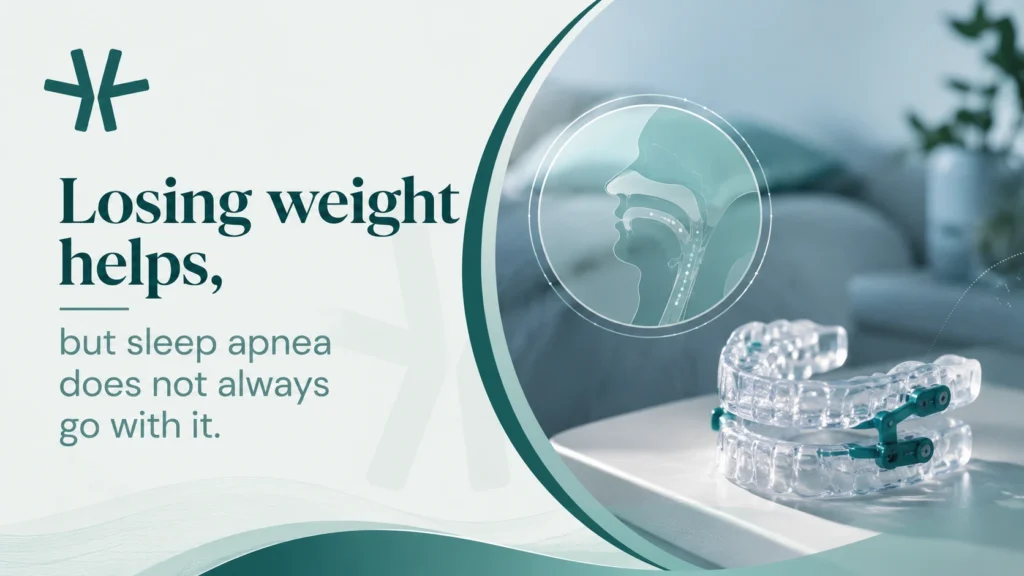
Custom oral appliance therapy is the most widely used and most evidence-supported non-CPAP treatment for obstructive sleep apnea. A custom-fitted device worn during sleep repositions the lower jaw slightly forward, increasing the space behind the tongue and soft palate where airway collapse typically occurs. Sleep apnea is fundamentally an airway and anatomy problem, and understanding the structural factors driving it is central to selecting and calibrating the right device. Patients exploring how jaw structure and inherited airway anatomy contribute to sleep apnea risk will find that context directly relevant to this treatment decision.
The American Academy of Sleep Medicine and the American Academy of Dental Sleep Medicine issued a joint clinical practice guideline recommending oral appliance therapy for adult patients with obstructive sleep apnea who are intolerant of CPAP or prefer an alternative. The guideline specifies a custom, titratable device, fitted and adjusted by a qualified provider based on the patient’s anatomy and clinical response, not a prefabricated or over-the-counter device.
Clinical research has consistently shown that oral appliance therapy achieves treatment success, defined as at least a 50% reduction in apnea events, in approximately two-thirds of patients when properly fitted and titrated. Studies have also demonstrated improvements in daytime sleepiness, blood pressure, and cardiovascular risk markers. Real-world compliance is consistently higher than with CPAP because the device requires no mask, no machine, and no power source. It is small, silent, and adjustable over time. For mild to moderate obstructive sleep apnea, it is a recognized first-line option.
Myofunctional Therapy
Myofunctional therapy consists of targeted exercises that strengthen the muscles of the tongue, soft palate, and throat, reducing their tendency to collapse during sleep. Systematic reviews of this approach have found reductions in apnea frequency of approximately 50% on average, with accompanying improvements in oxygen saturation and daytime sleepiness. It is most effective when airway obstruction is driven primarily by poor neuromuscular tone rather than structural anatomy, and it can function as a useful adjunct to oral appliance therapy in selected patients.
Positional Therapy
For a subset of patients, obstructive sleep apnea is significantly worse when sleeping on the back, where gravity causes the tongue and soft palate to fall into the airway. Research consistently shows that apnea frequency can be twice as high in the supine position compared with side sleeping, particularly in patients with lower overall apnea severity and near-normal body weight.
Positional therapy uses devices, wearable garments, or specialized support to discourage back sleeping throughout the night. Cochrane review data found that while CPAP achieved a greater absolute reduction in apnea events, patients receiving positional therapy maintained treatment for approximately 2.5 more hours per night, with meaningful real-world implications. Positional therapy is most useful as an adjunct to oral appliance therapy when a patient’s apnea has a clear positional component.
Weight Loss and Lifestyle Modifications
Excess body weight, particularly fat deposits in the neck and upper airway region, is one of the most significant modifiable risk factors for obstructive sleep apnea. Longitudinal research has found that meaningful weight loss produces proportional reductions in apnea frequency, and in cases of substantial weight loss, near-complete resolution of airway obstruction is possible in some patients.
Alcohol avoidance in the hours before sleep also reduces apnea severity. Alcohol has a selective depressant effect on the airway dilator muscles, and its regular use before bed has been associated with increased apnea frequency and lower overnight oxygen saturation. For most patients with established obstructive sleep apnea, lifestyle modifications serve as important supporting interventions rather than standalone treatment.
Hypoglossal Nerve Stimulation
Hypoglossal nerve stimulation is a surgically implanted device for patients with moderate to severe obstructive sleep apnea who have not achieved adequate results with CPAP. The device monitors breathing during sleep and delivers mild electrical stimulation to the hypoglossal nerve, which controls tongue movement, preventing airway obstruction with each breath.
Current FDA criteria include adults aged 22 or older with a documented inability to tolerate CPAP, an apnea-hypopnea index within a specified range, and a body mass index within a defined threshold. A drug-induced sleep endoscopy is required before implantation to confirm that the pattern of airway collapse is compatible with how the device functions. Five-year outcome data confirm durable improvements in apnea frequency and patient-reported quality of life. This is a more invasive pathway, most relevant for patients who have exhausted non-surgical alternatives.
Surgical Options
Surgery addresses the structural anatomy of the upper airway and is typically considered after conservative approaches have been tried without adequate results. Tissue reduction procedures, such as uvulopalatopharyngoplasty, widen the pharyngeal airway by removing or reshaping the uvula, soft palate, and tonsils, with success rates that vary depending on each patient’s anatomy. Maxillomandibular advancement, which moves both jaws forward to expand the skeletal framework around the airway, is among the higher-success surgical options for appropriately selected patients, though it involves significant recovery and a careful selection process. Surgical evaluation is conducted case by case, typically following drug-induced sleep endoscopy.
What Is the Newest Treatment for Sleep Apnea?
The FDA approved tirzepatide, sold under the brand name Zepbound, for the treatment of moderate to severe obstructive sleep apnea in adults with obesity, making it the first medication specifically approved for this indication. Clinical trials showed meaningful reductions in apnea frequency alongside weight loss outcomes. Patients already taking this medication who want to understand how it interacts with other treatment pathways can read more about oral appliance therapy and Zepbound used together.
How to Know Which Treatment Is Right for You
The right treatment depends on severity documented by a sleep study, the anatomy of your upper airway, and what you can realistically sustain. No treatment is effective if it is not used.
For most patients with mild to moderate obstructive sleep apnea, or those with more severe OSA who cannot tolerate CPAP, custom oral appliance therapy is the most accessible, effective, and sustainable first pathway. For patients with a significant positional component, combining positional therapy with an oral appliance often produces better outcomes than either alone. For patients with anatomical obstruction that has not responded to conservative treatment, surgical evaluation is appropriate.
Understanding what is driving your sleep apnea determines which option gives you the best chance of a lasting result. Many patients who have been living with loud snoring and unexplained fatigue find that getting properly evaluated is what finally changes things.
You Have More Options Than You Were Told
If CPAP has not worked, or if you were recently diagnosed and want to understand every option before committing to a treatment plan, the right next step is a medically guided evaluation.
Innova Sleep Institute in Brunswick, Georgia works with patients at exactly this point, people who have tried CPAP without lasting success, or who want a clear picture of every non-CPAP pathway available to them. A proper clinical evaluation tells you what is driving your sleep apnea and which treatment makes the most sense for your anatomy and severity.
Treating sleep apnea does not have to mean choosing between effective care and a comfortable night of sleep.