
CPAP is not working, and you are wondering if a mouth guard is a real alternative or just a cheaper version of something that will not help either.
Mouth guards do help with sleep apnea, but the outcome depends almost entirely on whether the device is a prescription custom appliance fitted to your specific anatomy, or a generic product bought without any clinical evaluation behind it. Those two things share a name and almost nothing else.
What Is a Sleep Apnea Mouth Guard?
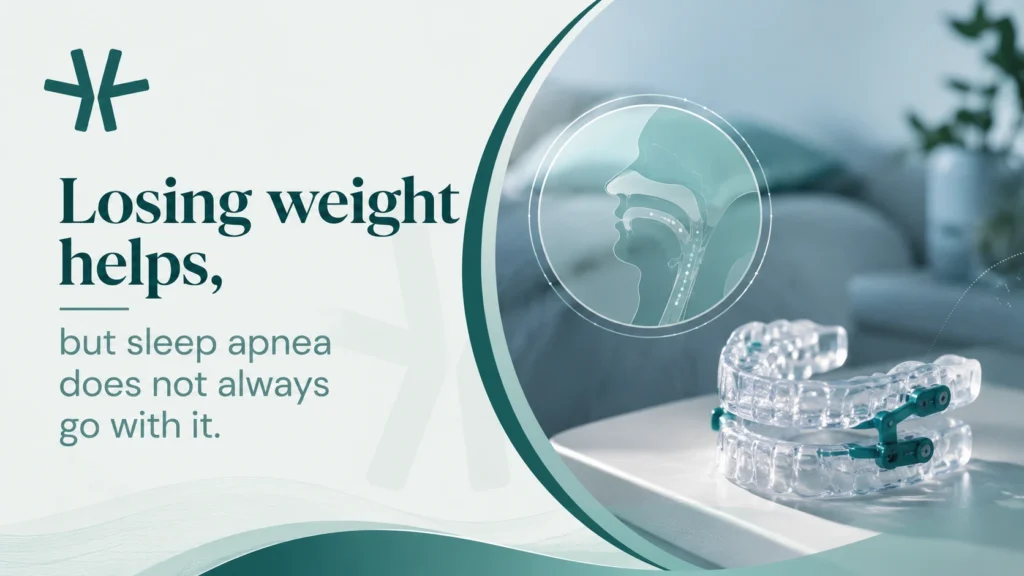
A sleep apnea mouth guard is a removable oral appliance worn during sleep that keeps the upper airway open by repositioning the jaw or tongue. The term “mouth guard” is patient language for what clinicians call an oral appliance or mandibular advancement device.
The device fits over the upper and lower teeth and holds the lower jaw in a slightly forward position throughout the night. That forward positioning changes the geometry of the upper airway, pulling the tongue and soft palate away from the back of the throat and maintaining space for unobstructed breathing. Without that repositioning, the muscles of the airway relax during sleep, soft tissue collapses inward, and breathing stops repeatedly throughout the night.
A second type, called a tongue-retaining device, holds the tongue forward through gentle suction rather than advancing the jaw. Clinicians use it in specific anatomical situations where jaw advancement alone is insufficient or not appropriate for the patient.
Do Mouth Guards Actually Work for Sleep Apnea?
Custom oral appliances, prescribed and fitted by a qualified provider following a formal sleep apnea diagnosis, are a clinically validated treatment for obstructive sleep apnea. The American Academy of Sleep Medicine and the American Academy of Dental Sleep Medicine issued a joint clinical practice guideline recommending oral appliance therapy for adult patients with obstructive sleep apnea who are intolerant of CPAP or who prefer an alternative.
When properly fitted and titrated to the patient’s anatomy, custom oral appliances achieve meaningful reductions in apnea frequency in the majority of patients, alongside improvements in daytime energy, blood pressure, cognitive function, and quality of life.
The word that determines everything in that sentence is custom. The outcomes documented across clinical settings apply to devices fabricated from precise dental impressions, fitted to the individual patient’s bite and jaw anatomy, and adjusted incrementally until the therapeutic target is reached. They do not apply to generic devices purchased without a prescription and without any clinical evaluation behind them.
Custom vs Over-the-Counter: Why the Difference Matters Clinically
The most important distinction any patient researching sleep apnea mouth guards needs to understand is the one between a prescription custom appliance and an over-the-counter device.
Over-the-counter mouthguards use a boil-and-bite or fixed generic fit. The jaw advancement position is predetermined and cannot be adjusted to the individual patient’s anatomy or apnea severity. The American Academy of Sleep Medicine explicitly does not recommend over-the-counter devices as a treatment for obstructive sleep apnea. A device not calibrated to a patient’s specific anatomy and apnea pattern cannot reliably produce the clinical outcomes a properly fitted appliance can.
A custom oral appliance starts with a formal sleep apnea diagnosis through an accredited sleep study. Precise dental impressions or digital scans are taken to fabricate the device to the patient’s exact specifications. After delivery, a titration process follows where the jaw advancement position is adjusted incrementally based on symptom response and objective monitoring of sleep quality and apnea frequency. The goal is the minimum effective advancement that resolves apnea events without producing jaw discomfort or dental side effects.
That titration process, guided by a clinician with expertise in airway anatomy, is where treatment outcomes are determined. Clinical precision in fitting, adjusting, and monitoring the device over time is what produces the result, not the device alone.
Who Is a Good Candidate for a Sleep Apnea Mouth Guard?
Patient selection is the factor that most influences whether oral appliance therapy succeeds. The treatment works mechanically, not universally, and the anatomical and clinical characteristics of the patient determine how well the device can address their specific pattern of airway collapse.
Patients who tend to respond best include those with mild to moderate obstructive sleep apnea, those whose airway obstruction is driven by jaw position and tongue displacement rather than primarily by excess soft tissue volume, those with a retruded lower jaw or narrower pharyngeal space, and those who cannot tolerate or sustain CPAP therapy. For patients with more severe obstructive sleep apnea who cannot achieve consistent CPAP use, a properly fitted oral appliance worn nightly produces more clinical benefit than a machine that sits unused.
Patients less likely to benefit include those with central rather than obstructive sleep apnea, those with significant active dental disease or insufficient dentition to support the appliance, those with temporomandibular joint conditions that limit jaw advancement, and those with significant nasal obstruction requiring independent management.
A proper sleep study and clinical evaluation of upper airway anatomy, dental health, and jaw function are the starting points for determining candidacy. A device chosen based on self-assessed symptoms is not a substitute for that process.
What About Side Effects?
Custom oral appliances are generally well tolerated. The most common side effects include temporary jaw soreness on waking, which diminishes as the patient adapts, and dry mouth or increased salivation during the initial adjustment period. With longer-term use, minor shifts in bite or tooth position can develop and require monitoring during follow-up appointments. Within a supervised treatment relationship, these changes are typically small and manageable. Without clinical oversight, they are far more likely to go unaddressed.
Does Insurance Cover a Sleep Apnea Mouth Guard?
Custom oral appliance therapy is covered as a medical benefit under most major insurance plans, including Medicare, for patients with a formal sleep apnea diagnosis. Coverage falls under durable medical equipment benefits, not dental benefits. Practices specializing in oral appliance therapy typically manage benefits verification and pre-authorization on the patient’s behalf. Over-the-counter devices are not covered because they are not prescribed treatments for a diagnosed medical condition.
Why the Anatomy Behind the Appliance Matters
Obstructive sleep apnea is fundamentally an airway and anatomy problem. Jaw position, tongue size relative to the oral cavity, soft palate length, and pharyngeal width all determine how much space exists before soft tissue collapse obstructs breathing during sleep.
When jaw structure and airway geometry run in the family, a device calibrated precisely to those inherited characteristics often produces the most predictable clinical outcome. For patients who have already ruled out CPAP, understanding what non-CPAP treatment actually looks like in practice helps frame the conversation before the first appointment.
Finding Out If a Custom Oral Appliance Is Right for You
A generic mouthguard from a pharmacy shelf and a custom oral appliance prescribed following a formal sleep apnea diagnosis are not the same treatment. One is a consumer product. The other is a medically supervised pathway fitted to the patient’s specific anatomy and apnea severity, monitored over time, and adjusted as clinical needs evolve.
If you have been diagnosed with sleep apnea and want a clear answer about whether a custom oral appliance fits your situation, Innova Sleep Institute in Brunswick, Georgia provides medically guided evaluation and custom oral appliance therapy built around your individual clinical picture. A proper evaluation gives you a clinical answer, not a guess based on a product description.