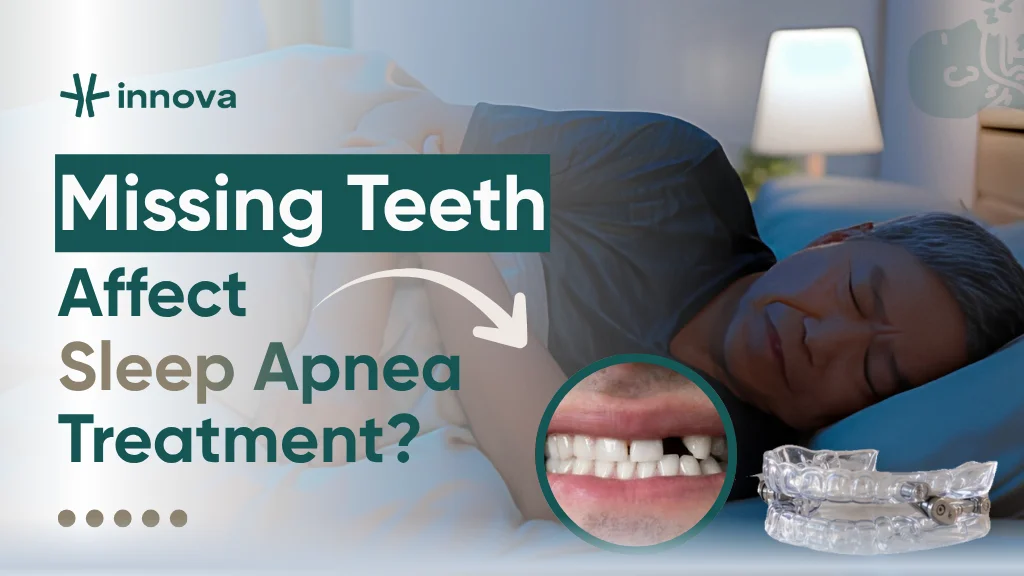
Missing teeth do not automatically rule out oral appliance therapy for sleep apnea. Whether a custom device is feasible depends on which teeth remain, where they are located, how structurally sound they are, and whether an appliance can be designed around the specific dental picture.
For patients with several missing teeth but a healthy remaining dentition, clinicians can often still fit a custom mandibular advancement device effectively. For patients with complete tooth loss and no implant-supported prostheses, a standard oral appliance is generally not feasible. Most patients with missing teeth fall somewhere in between, and a clinical evaluation is the only way to determine which category applies.
How an Oral Appliance Works and Why Dental Support Is Required
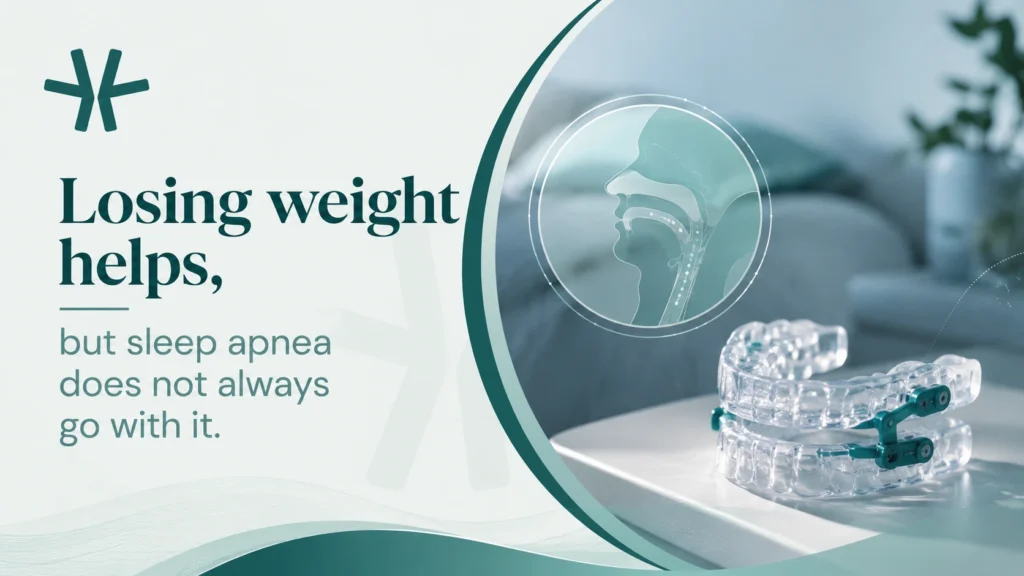
A mandibular advancement device, the most widely used oral appliance for obstructive sleep apnea, fits over the upper and lower teeth and holds the lower jaw slightly forward during sleep. That repositioning changes the geometry of the upper airway, maintaining space that reduces the soft tissue collapse responsible for breathing interruptions during sleep.
The device functions by gripping the teeth. The dental arches provide the anchor points that keep the appliance in position, transmit the advancement force to the jaw, and prevent the device from shifting or dislodging throughout the night. Without sufficient teeth in the right positions, the appliance lacks a stable foundation and cannot function as intended.
This is why dental support is a formal candidacy requirement in oral appliance therapy. Published clinical research consistently lists adequate dentition as an inclusion criterion, with full dentures, loose teeth, and advanced periodontal disease appearing as exclusion factors. The standard is not a complete set of teeth. It is enough structurally sound teeth, distributed in a way that allows a custom device to be fabricated and retained through the night.
Tooth Loss and Sleep Apnea: What the Evidence Shows
Tooth loss and obstructive sleep apnea tend to appear together more often than chance would predict, though the relationship between them is not straightforward. The leading explanation involves what happens structurally after teeth are lost. Changes in jaw position, a reduction in lower facial height, and shifts in how the tongue and soft tissues rest in the throat can all follow significant tooth loss. Those structural changes overlap with the anatomy that drives airway collapse during sleep, which is why clinicians who treat both conditions have noticed the pattern.
The research on this is real but limited. Studies have found the association consistently enough to take it seriously, but the data are too varied in design and diagnostic method to draw firm conclusions about cause and effect. Tooth loss does not cause sleep apnea in any direct sense. What it may do is alter the airway environment in ways that make some people more vulnerable, or make existing apnea harder to manage.
For patients with significant tooth loss who are also experiencing sleep apnea symptoms, that context matters. It means the dental picture and the airway picture are worth evaluating together, not separately.
What Candidacy Depends On
There is no universal minimum tooth count that determines whether a patient can use an oral appliance. Candidacy is determined by the combination of remaining teeth, their condition, and their distribution, evaluated by a clinician who can assess whether a device can be designed and retained for that specific patient.
Several factors are assessed together:
Number and location of remaining teeth. Posterior teeth, meaning molars and premolars, carry most of the retention and load distribution for a mandibular advancement device. A patient missing several anterior teeth but retaining healthy posterior teeth on both arches may remain a viable candidate. A patient with extensive posterior tooth loss presents a more complex picture, since those teeth are where most of the retention force is anchored.
Periodontal health. A tooth that is mobile due to active gum disease provides unreliable anchor support regardless of how many remain. Patients with untreated periodontal disease are typically advised to address that before proceeding with an oral appliance evaluation, both because of the anchor stability requirement and because active periodontal disease can affect surrounding bone over time.
Bone level beneath remaining teeth. Teeth that appear intact but have significant underlying bone loss carry a different structural load capacity than teeth with healthy supporting bone. Radiographic assessment is part of the dental evaluation for this reason.
Planned dental work. An anticipated extraction or implant placement can affect which appliance design makes sense and when fabrication should proceed. This is factored into the evaluation and timing decisions.
Candidacy by Dental Situation
Several missing teeth, healthy remaining dentition: Patients missing a limited number of teeth, particularly anteriors, who retain structurally sound posterior teeth on both arches, often remain good candidates for custom oral appliance therapy. The device can be designed around the gaps, with retention distributed across the available teeth. The key variable is whether the remaining teeth are healthy enough to support the appliance reliably over time.
Partial dentures: Patients who wear partial dentures present a variable clinical picture. Some retain enough natural teeth to support an oral appliance independently of the denture. In others, the partial denture may be incorporated into the appliance design. Candidacy depends on what natural teeth remain and whether the prosthetic design is compatible with the mechanical requirements of a mandibular advancement device.
Dental implants: Implant-supported prostheses can, in certain configurations, provide anchor support for an oral appliance. A 2026 scoping review published in Sleep and Breathing examined clinical considerations for oral appliance use in patients with dental implants and found that implants do not categorically exclude a patient from oral appliance therapy, though the evidence base is limited and each case requires individual assessment. The relevant factors include implant location, the prosthetic restoration design, and the degree of jaw advancement needed for therapeutic effect.
Full dentures without implants: Patients with complete dentures and no implant-supported prostheses face the most significant barrier. A mandibular advancement device requires natural teeth or implant-supported structures to anchor the appliance. Standard oral appliance therapy is generally not feasible in this situation. Some patients in this category explore dental implant placement to create the dental foundation needed for appliance-based sleep apnea treatment, though this is a significant clinical undertaking and not a routine step. Others work with their physician to evaluate whether other treatment pathways are a better fit for their situation.
Tongue Stabilizing Devices: A Different Mechanical Approach
For patients who cannot use a mandibular advancement device due to insufficient dental support, a tongue stabilizing device represents a different mechanical approach worth discussing with a clinician.
Rather than advancing the lower jaw through tooth attachment, a tongue stabilizing device holds the tongue in a forward position using a suction mechanism that doesn’t require teeth for anchorage. This makes it an option for some patients who lack adequate dentition for a standard mandibular advancement device.
The evidence base for tongue stabilizing devices is limited. A crossover randomized controlled trial of 27 patients comparing a tongue retaining device with CPAP found that both significantly reduced apnea frequency, though CPAP was substantially more effective. The trial had a short follow-up period of three weeks per arm, which limits the conclusions that can be drawn about long-term outcomes. Tongue stabilizing devices are not first-line treatment and are not appropriate for every patient who lacks sufficient dentition for a mandibular advancement device. They remain a pathway worth raising during the clinical evaluation for selected patients in that situation.
What the Clinical Evaluation Involves
Candidacy for oral appliance therapy in a patient with missing teeth requires two assessments. A physician-ordered sleep study establishes the diagnosis and documents severity. A clinical dental evaluation then determines whether the patient’s specific dental status can support a custom appliance, and if so, what design makes sense.
The dental evaluation includes a clinical examination of all remaining teeth, an assessment of periodontal health, radiographic imaging to evaluate bone support levels, and a review of jaw range of motion. It also accounts for any planned dental work that may affect timing or design.
Patients already familiar with the broader range of non-CPAP treatment options will find that oral appliance therapy remains worth investigating even with a complex dental picture, because the evaluation itself establishes what is and is not workable for that specific patient.
The Question Is Whether Your Situation Is Workable
Patients who assume their dental situation has already ruled out oral appliance therapy often reach that conclusion before anyone has actually evaluated them. Many find that their specific picture is workable once it has been assessed by a clinician who understands both airway anatomy and appliance requirements.
Sleep apnea needs treatment. Missing teeth make the treatment question more complex, but they do not answer it in advance. If you have been diagnosed with obstructive sleep apnea and want to understand whether your dental status affects your options, Innova Sleep Institute in Brunswick, Georgia provides medically guided evaluation and custom oral appliance therapy for patients whose situations require careful clinical assessment.