
If you have been diagnosed with obstructive sleep apnea and are struggling to manage your weight despite reasonable effort, the relationship between those two problems may be more relevant than it appears. Sleep apnea and body weight influence each other in both directions, and for some patients that cycle creates conditions that make weight management harder than it would otherwise be. Understanding the relationship explains why treating the sleep disorder is often a meaningful part of addressing the broader clinical picture, even if it is not a solution to weight concerns on its own.
Does Sleep Apnea Cause Weight Gain?
The relationship between obstructive sleep apnea and weight gain runs in both directions, and neither direction is simple or universal.
Excess weight is one of the most well-established risk factors for sleep apnea. At the same time, some research suggests that untreated sleep apnea may create conditions that make weight management harder for certain patients. The evidence for this second direction is real but should be read carefully: not every person with sleep apnea will experience weight gain as a result, and the strength of individual mechanisms varies across studies.
What the research does support is that the bidirectional relationship exists, that it is clinically recognized, and that both sides deserve attention when a patient is dealing with both problems at once.
Can Weight Gain Cause Sleep Apnea?
Yes, and for many patients this is where the problem begins.
Excess weight, particularly around the neck and throat, can add soft tissue that narrows the upper airway. During sleep, when the muscles that normally help hold the airway open relax, that narrowing increases the risk of partial or complete airway collapse. This is one of the reasons excess weight is listed as a primary risk factor for obstructive sleep apnea in clinical guidelines.
It is worth noting that weight is not the only cause. Sleep apnea occurs in people of normal body weight as well, and factors such as airway anatomy, jaw position, and age all play a role. But for patients who carry significant weight in the neck and upper chest, addressing weight is often part of the clinical picture alongside sleep apnea treatment.
How Sleep Apnea May Affect the Hormones That Regulate Weight
One proposed mechanism connecting sleep apnea to weight involves the hormones that regulate hunger and fullness. Obstructive sleep apnea fragments the sleep cycle through repeated breathing interruptions, and disrupted sleep has been associated with changes in appetite-related hormones in a number of studies.
The two most studied hormones in this context are ghrelin and leptin.
Ghrelin is a hormone that signals hunger. Research has associated insufficient and fragmented sleep with elevated ghrelin levels in some populations, though results vary across studies and the independent contribution of sleep apnea specifically, separate from excess weight, is difficult to isolate.
Leptin is a hormone that signals fullness. Elevated leptin levels have been reported in patients with OSA in some research, which may reflect leptin resistance rather than a simple suppression of the signal. This is different from what earlier simplified explanations suggested, and the picture is not yet fully resolved in the literature.
The practical implication is that patients with untreated sleep apnea may find appetite regulation more difficult, though the degree to which this is driven by the apnea itself versus related factors such as weight, sleep deprivation, or metabolic health varies from person to person.
The Metabolic Effects Associated With Untreated Sleep Apnea
Beyond hormone signaling, research has examined several metabolic effects in patients with obstructive sleep apnea.
Glucose regulation. Clinical studies have found elevated fasting blood glucose and higher rates of newly diagnosed type 2 diabetes in patients with OSA compared to matched controls, even after accounting for weight. The mechanism is not fully established, but the repeated physiological stress of apnea events is thought to be a contributing factor. Disrupted glucose metabolism is associated with changes in how the body stores energy, though presenting this as a guaranteed consequence for every patient would overstate the evidence.
Cortisol. Elevated cortisol has been measured in some patients with OSA, and some studies have documented higher overnight and 24-hour cortisol levels compared to matched controls. The relationship between OSA and cortisol is not consistent across all research, and factors such as obesity, stress, and sleep deprivation all influence cortisol independently. Elevated cortisol is associated with central fat deposition in general, but the causal role of sleep apnea specifically remains an area of ongoing research rather than established fact.
Fatigue and physical activity. The chronic tiredness that accompanies untreated sleep apnea can reduce motivation and capacity for physical activity. This is one of the more clinically consistent findings: patients with untreated OSA report significant fatigue that affects their daily functioning. Whether reduced activity from fatigue contributes meaningfully to weight gain over time is plausible, though individual variation is significant.
Why Weight Management Can Feel Harder Than Expected
For patients dealing with untreated sleep apnea, weight management may feel disproportionately difficult. The mechanisms described above offer a partial explanation for why that could be the case in some patients: disrupted appetite signaling, impaired glucose regulation, and persistent fatigue each represent a possible challenge.
It is important to frame this accurately. These mechanisms do not guarantee that every person with sleep apnea will struggle with weight, and they do not mean that dietary effort and exercise cannot produce results. What they suggest is that some patients may be managing weight under conditions that make it harder than the effort alone would explain.
Recognizing that possibility is relevant not because it removes the need for behavioral change, but because it points toward addressing the sleep disorder as part of the broader clinical picture.
Does Treating Sleep Apnea Help With Weight?
This is an area where the evidence requires careful reading.
Treating obstructive sleep apnea addresses the sleep disorder itself and the symptoms associated with it, including fragmented sleep, daytime fatigue, and the physiological stress of repeated apnea events. Whether treating sleep apnea leads to weight loss is a separate question, and the evidence on that point is mixed.
Some randomized trials and reviews have found no significant change in weight or BMI after CPAP treatment, and some have found modest average weight increases compared to control groups. This does not mean treatment should be avoided. It means that sleep apnea treatment should not be presented or understood as a weight loss intervention.
What treating sleep apnea may do is remove one contributing factor from a complex picture, and allow patients to engage more fully with dietary and activity changes when fatigue is better managed. That is a reasonable expectation. A guarantee of weight loss is not.
The Problem With Treatments You Cannot Sustain
Consistent nightly use is necessary for sleep apnea treatment to be effective. A therapy that a patient cannot tolerate or will not use regularly does not address the underlying disorder.
CPAP is an effective treatment when used consistently, and it is the standard first-line option for most patients with moderate to severe OSA. A portion of patients, however, do not sustain nightly CPAP use due to mask discomfort, pressure intolerance, or the practical burden of managing the equipment. Clinical estimates of adherence vary widely across studies, and defining “consistent use” differs by research protocol, so specific percentages should be interpreted with that in mind.
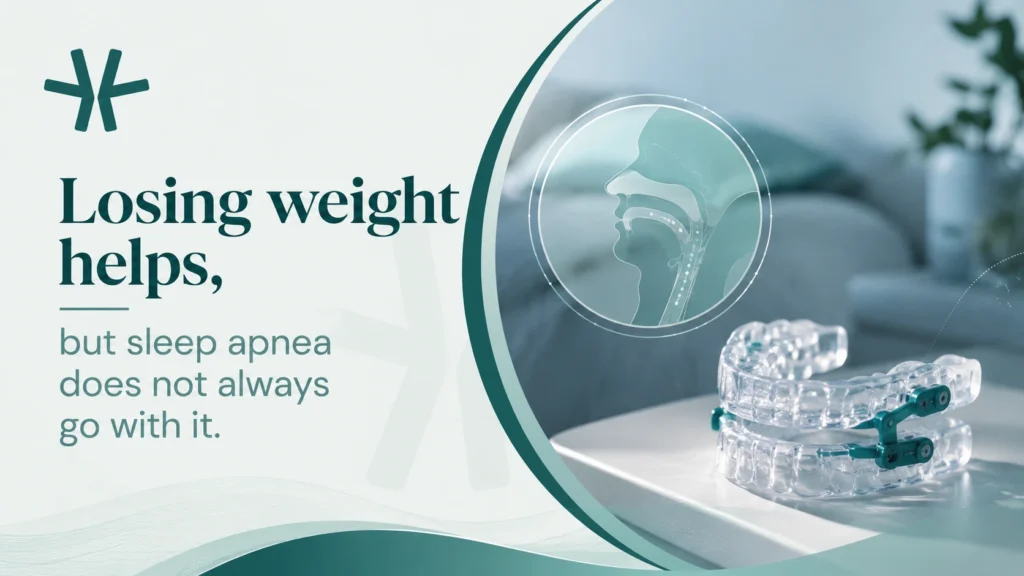
For patients who have not sustained CPAP use, exploring the broader range of non-CPAP treatment options is clinically appropriate. Custom oral appliance therapy is supported by clinical guidelines as an alternative for adults with OSA who cannot tolerate CPAP or who prefer a different approach. Like any treatment, its effectiveness depends on appropriate patient selection, device titration, and follow-up to confirm that it is working.
What a Proper Evaluation Looks Like
If you have obstructive sleep apnea and are also finding weight management difficult, both issues deserve evaluation as part of the same clinical conversation rather than being treated as entirely separate.
A sleep study establishes the diagnosis and documents the disorder’s severity. A clinical evaluation of treatment options then considers which approach best fits the patient, taking into account diagnosis, anatomy, medical history, and the patient’s ability to use a given treatment consistently.
For patients who have tried CPAP and found it unsustainable, custom oral appliance therapy is a clinically recognized alternative. Whether it is appropriate depends on individual clinical factors including OSA severity, dental status, and jaw anatomy. Follow-up after treatment begins is needed to confirm that the device is effective for that patient’s specific situation.
Suitability for any treatment is determined by evaluation, not by assumption in either direction.
Sleep Apnea and Weight: The Realistic Picture
Sleep apnea and body weight are connected by a relationship that runs in both directions and involves more than any single mechanism. Treating sleep apnea does not automatically resolve weight concerns, and managing weight does not automatically resolve sleep apnea. Both deserve appropriate clinical attention.
What treating sleep apnea consistently can do is address the sleep disorder and its associated symptoms, which may make other aspects of health management more manageable for some patients. That is a realistic expectation grounded in what the evidence supports.
If you have been diagnosed with obstructive sleep apnea and want to understand your treatment options, Innova Sleep Institute in Brunswick, Georgia provides physician-guided evaluation and custom oral appliance therapy for patients who are looking for an approach they can sustain.