
Getting a sleep apnea diagnosis does not automatically mean a CPAP machine is your only path forward. For a growing number of patients, it is not even the first option their physician recommends. Oral appliance therapy has moved from a niche alternative into a well-established, guideline-supported treatment that works for a wide range of patients, including some with more severe disease than most people assume.
Knowing how oral appliance therapy works, who it works for, and what the evidence says puts you in a much stronger position when talking with your physician about whether it belongs in your treatment plan.
What Is Oral Appliance Therapy for Sleep Apnea?
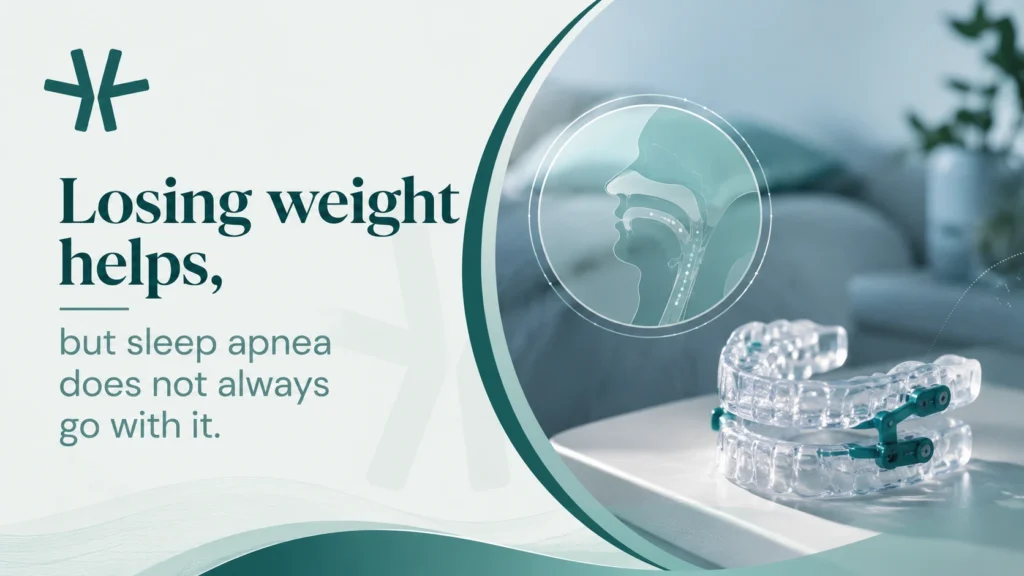
Oral appliance therapy uses a custom-fitted device worn during sleep to keep the upper airway open and prevent the airway collapse that causes obstructive sleep apnea. The device fits over the upper and lower teeth, similar in appearance to a sports mouthguard or orthodontic retainer, but functions as a precisely calibrated medical device rather than a generic mouth protector.
The most widely used category is the mandibular advancement device. It holds the lower jaw in a slightly forward position during sleep, changing the geometry of the upper airway and pulling the tongue and soft palate away from the back of the throat to maintain space for unobstructed breathing throughout the night.
A second category, tongue-retaining devices, holds the tongue forward directly rather than through jaw repositioning. Clinicians use them in specific situations where jaw advancement alone is not appropriate or sufficient.
The distinction between a custom oral appliance and an over-the-counter mouthpiece matters enormously. Custom devices are fabricated from precise dental impressions or digital scans of the individual patient’s dentition and bite. They are adjustable, allowing the treating clinician to advance or retract the jaw position incrementally until the therapeutic target is achieved. Over-the-counter devices use a generic fit that cannot be calibrated to anatomy or apnea severity and are not recommended by the American Academy of Sleep Medicine as a treatment for obstructive sleep apnea.
How Effective Is Oral Appliance Therapy?
Clinical research consistently shows that mandibular advancement devices improve obstructive sleep apnea in the majority of properly selected patients. When fitted and titrated correctly, approximately two-thirds of patients achieve meaningful reductions in apnea frequency. For many, improvements extend beyond apnea reduction to include better daytime energy, more stable blood pressure, sharper cognitive function, and improved mood.
CPAP produces a larger reduction in the apnea-hypopnea index under controlled study conditions. In real-world use, however, oral appliances are used more consistently. Nearly half of CPAP users discontinue therapy within three years due to discomfort, noise, and the practical burden of nightly use. Consistent treatment is what produces lasting health benefits, and oral appliances, being smaller, quieter, and easier to maintain, sustain that consistency far more reliably for patients who cannot or will not use CPAP every night.
Who Is a Good Candidate for Oral Appliance Therapy?
The American Academy of Sleep Medicine and the American Academy of Dental Sleep Medicine issued a joint clinical practice guideline recommending oral appliance therapy for adult patients with obstructive sleep apnea who are intolerant of CPAP or prefer an alternative. For patients with mild to moderate OSA, oral appliance therapy is a recognized first-line option, not a secondary fallback. For those with more severe OSA who cannot sustain CPAP compliance, it remains a clinically supported pathway with meaningful outcomes documented in published research.
Anatomical factors also shape candidacy. Patients with a retruded lower jaw, a narrower pharynx, or a tongue that tends to fall back during sleep tend to respond particularly well because mandibular advancement directly addresses the structural factors driving their airway collapse.
Patients less likely to benefit from oral appliance therapy as a primary solution include those with significant nasal obstruction requiring independent treatment, central rather than obstructive sleep apnea, or temporomandibular joint conditions that limit comfortable jaw advancement.
A proper sleep study and clinical evaluation of upper airway anatomy, dental health, and jaw function are needed to identify which category a patient falls into. Skipping that step produces a device that cannot be matched to the patient’s anatomy or apnea pattern, and the outcomes reflect that gap.
What Does the Treatment Process Actually Look Like?
A physician-ordered sleep study is the necessary first step, either in a lab or through an accredited home sleep testing protocol. Without a formal diagnosis and documented severity, selecting or calibrating a treatment device has no clinical foundation, and insurance coverage will not apply.
Once a diagnosis is established, a clinical evaluation of the patient’s dental health, jaw anatomy, and upper airway geometry informs appliance selection and the starting advancement position. Digital or physical dental impressions are taken to fabricate the custom device.
After delivery, a titration process follows. The jaw advancement position is adjusted incrementally over several appointments, guided by symptom response and objective monitoring of sleep quality and apnea frequency. The goal is the minimum effective advancement position that resolves apnea without producing jaw discomfort or dental side effects.
Long-term follow-up is part of the treatment. Appliances can shift dental positions over time, jaw adaptation can change the effective advancement, and apnea severity can evolve as weight or other health factors change. Ongoing monitoring ensures the device continues to perform as intended.
Why the Expertise Behind the Device Matters
Effectiveness depends not only on the device itself but on the clinical judgment applied in selecting it, fitting it, titrating it, and monitoring it over time.
The anatomy that determines how well oral appliance therapy works, including jaw position relative to the skull, palate shape, tongue size, and pharyngeal airway geometry, falls directly within the scope of training for an oral and maxillofacial surgeon. Addressing a specific patient’s airway pattern requires anatomical precision that goes beyond what a generalist setting can provide.
The American Academy of Dental Sleep Medicine guideline specifies a custom, titratable device managed by a qualified provider with specific training in dental sleep medicine, not simply any provider who can fabricate an appliance. The clinical decision-making applied in selecting, fitting, and monitoring the device determines the outcome. Fabrication alone does not.
For patients whose sleep apnea risk runs in the family, the jaw and airway anatomy inherited from a parent is often exactly what makes oral appliance therapy the most precise and effective treatment pathway available to them.
Does Insurance Cover Oral Appliance Therapy?
For patients with a formal sleep apnea diagnosis documented through an accredited sleep study, oral appliance therapy is typically covered as a medical benefit under most major insurance plans, including Medicare. Coverage falls under durable medical equipment benefits, not dental benefits, and is processed through medical insurance regardless of the prescribing provider type.
Coverage terms, required documentation, and cost-sharing vary by plan. Practices that specialize in oral appliance therapy typically handle benefits verification and pre-authorization on behalf of the patient, removing one of the most common barriers between diagnosis and starting treatment.
Finding Out If It Is Right for You
Oral appliance therapy does not suit every patient. For the right patient, it offers an effective, comfortable, and sustainable way to address the anatomical cause of sleep apnea without a machine, a mask, or a power source.
If you want a precise answer about whether oral appliance therapy is the right fit for your specific anatomy and severity, Innova Sleep Institute in Brunswick, Georgia provides medically guided sleep apnea evaluation and custom oral appliance therapy built around your individual clinical picture. A proper evaluation gives you the data you need to make that decision with confidence, not guesswork. Patients already familiar with the broader range of available treatment options can also review how oral appliance therapy compares to other non-CPAP pathways before their consultation.